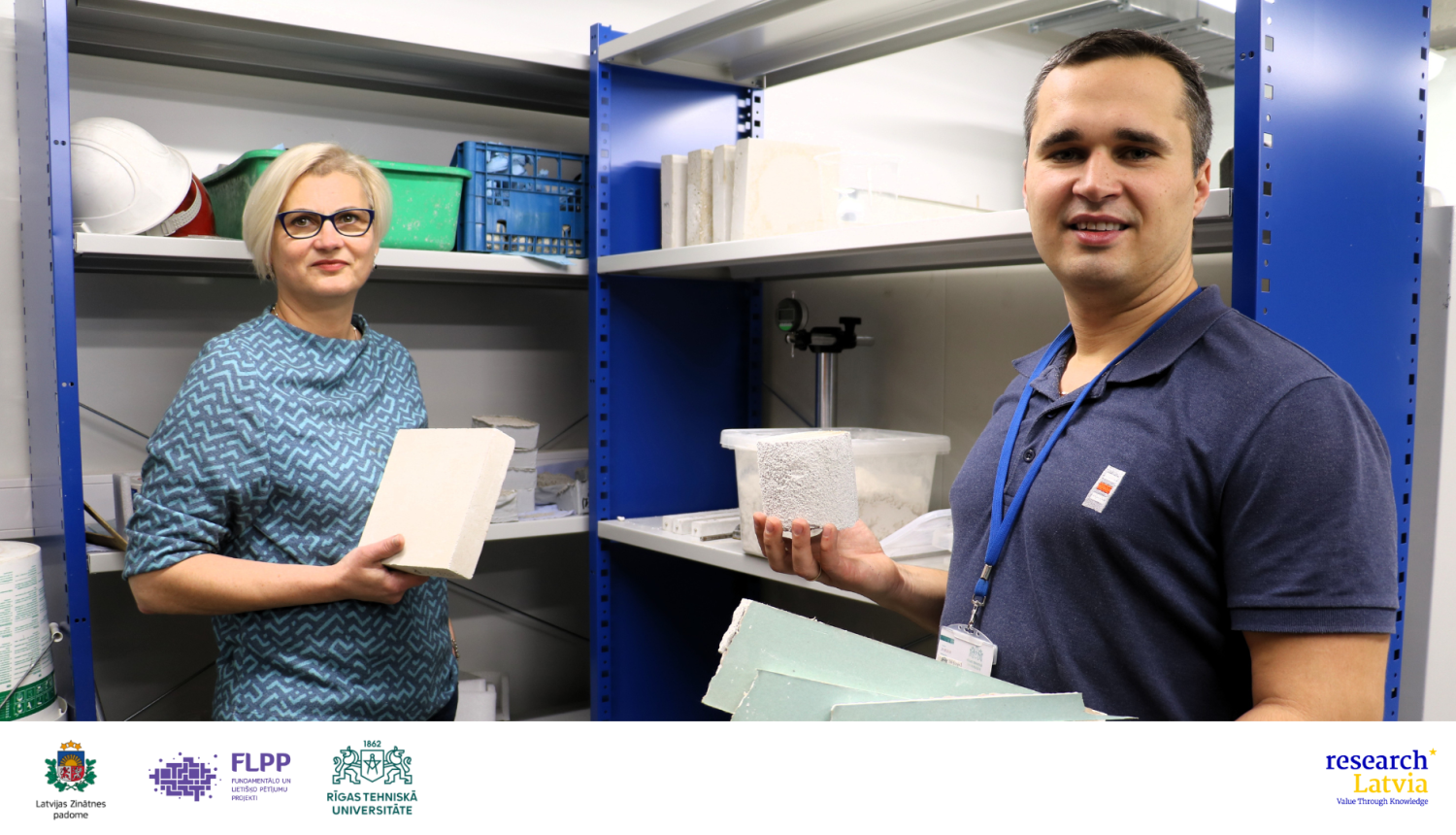
The Latvian Science Council's administered fundamental and applied research program project "Utilization of Gypsum and Polymer-containing Construction Waste for the Production of Panels with Enhanced Sound Absorption and Thermal Insulation Properties," implemented by Riga Technical University, stands out with an innovative approach by using recycled gypsum and polystyrene to create panels with improved sound and thermal insulation properties. The project's leader, RTU Faculty of Civil Engineering (BIF) tenured professor Diāna Bajāre, reveals that it is our collective responsibility to work towards building a more sustainable future for all. As natural resources are finite and the volume of waste continues to grow, this project is especially significant in promoting the recycling and utilization of construction waste in line with the EU Circular Economy Strategy.
Sustainable Building Materials and Their Importance
The key concept of this research is sustainable building materials, which aim to promote the efficient use of resources, protect the environment, reduce the consumption of non-renewable resources, and create new raw materials from renewable resources. This approach also helps reduce CO₂ emissions and ensures environmentally friendly construction methods. When a building reaches the end of its useful life, it is dismantled, creating construction waste, one of which is gypsum board. It is a misconception that gypsum is a widely available material in nature, so it is easier to take new material from nature without considering that these waste materials contribute to soil and groundwater pollution, as well as overload landfills. Even though gypsum is relatively accessible, using it in this way contradicts the basic principles of the circular economy, which we need to actively pursue.
Circular Economy Approach
The circular economy is a globally relevant trend and particularly important in the construction sector and our everyday lives. Simply put, it is how we can sustainably ensure our lives. We sort waste, install solar panels, choose more natural materials, and similar practices should be considered in the construction industry. This means careful resource management, developing new materials, and reducing waste volumes.
Project leader, Professor Diāna Bajāre from the Faculty of Civil Engineering at Riga Technical University (RTU), emphasizes: "To implement this type of project, we cannot focus narrowly; we need an interdisciplinary approach involving economists, engineers, and other specialists. The focus is on how we can build using new materials that can later be recycled or reused, ensuring effective properties that improve the building's microclimate while reducing the overall material costs."
Practical Example – Gypsum Board Recycling
Under the project, Associate Professor Ģirts Būmanis led a team of scientists to explore the recycling of gypsum board waste. They studied how to more effectively recover and reuse gypsum board by optimizing processing parameters such as temperature and time. This material was used to develop new composite materials with enhanced thermal and sound insulation properties. "We created a material that is comparable in properties to existing market products but is more environmentally friendly, as it is made from construction waste. At the same time, we aim to reduce the volume of waste generated during demolition processes by reusing it, saving newly extracted materials. If we use recycled gypsum binders, we don't need to use as much gypsum stone. This is the circular economy – if we can do this, the harm to nature is much lower," says Ģirts. "This created material is one or even two steps ahead of what society is currently ready for. There are still prejudices that people want new, not recycled or old materials. To introduce something new, society must be actively informed. Initially, we can use 90% conventional materials and 10% recycled, gradually increasing the proportion of recycled material. I believe that this will reduce the prejudices because people will see that these materials are not worse and even better."
Educating the New Generation and the Public
This and other projects focus not only on ensuring a better future for society but also on involving new scientists. "We need to involve students in projects, and we are happy to do so. From a human resources perspective, nearly half of the workload in the project is delegated to doctoral and master's students. We devote a lot of time to educating young students so that their qualification papers are well developed, and they gain knowledge and interest in advancing their academic careers."
Public awareness is another pillar of all the projects. "We participate in popular science events, write popular science articles, organize seminars and conferences, and even travel to other countries. It is very important to inform everyone so they know what we are doing," explains Diāna.
Result – Industry and Society Heard Us!
Such projects are impossible without close collaboration with the industry and its interest. There are various European directives related to climate protection and CO₂ emission reduction, which encourages companies to introduce more circular economy practices into their production to develop greener construction practices. For example, a global gypsum extraction and processing company is interested in developing such innovations. "We are noticed thanks to scientific publications in international journals. We are involved in forming scientific groups to continue solving global issues in the gypsum industry, with researchers from Canada, Hong Kong, and across Europe participating," Diāna proudly shares. Latvian researchers are actively participating in various international projects, collaborating with companies in global innovation programs. "Valmiera Glass" also got acquainted with this research and saw an opportunity to address an important issue—further sustainable use of by-products generated during their production process in the manufacturing of building materials. The company has approached the researchers of this project to help solve the issue.
A great source of pride is the fact that the material created during this project has received a Latvian patent!
"The results of the project confirm that sustainable construction not only helps preserve natural resources but also improves quality of life by ensuring a harmonious balance between the needs of the present and the possibilities for future generations. We are keeping up with global trends, as resource conservation and efficient use mean a better life for future generations!" proudly states project leader Diāna Bajāre.
------------------
The project "Utilization of Gypsum and Polymer-containing Construction Waste for the Production of Panels with Enhanced Sound Absorption and Thermal Insulation Properties" (Lzp-2020/1-0010) is implemented under the Fundamental and Applied Research Program (FLPP), funded by the Latvian Science Council.